
AI Agents for Business: Real-World Use Cases, Risks, and How to Start Small
AI agents act towards goals rather than just answering prompts. Discover key differences from chatbots and automations, 6 practical business use cases, operational risks, and a 5-step rollout guide.
AI agents represent one of the most widely discussed technological frontiers this year, but most technical explanations are tailored to enterprise corporations with hundreds of engineers. For small-to-medium business owners in Israel, the core question is pragmatic: what can an AI agent actually accomplish for my business right now? This guide breaks down the technology into straightforward business terminology. We explain how agents fundamentally differ from chatbots and static automations, examine 6 operational workflows currently deployed across Israeli SMBs, address real-world risks, and present a low-risk 5-step implementation roadmap.
AI Agents vs. Chatbots vs. Automations: What is the Real Difference?
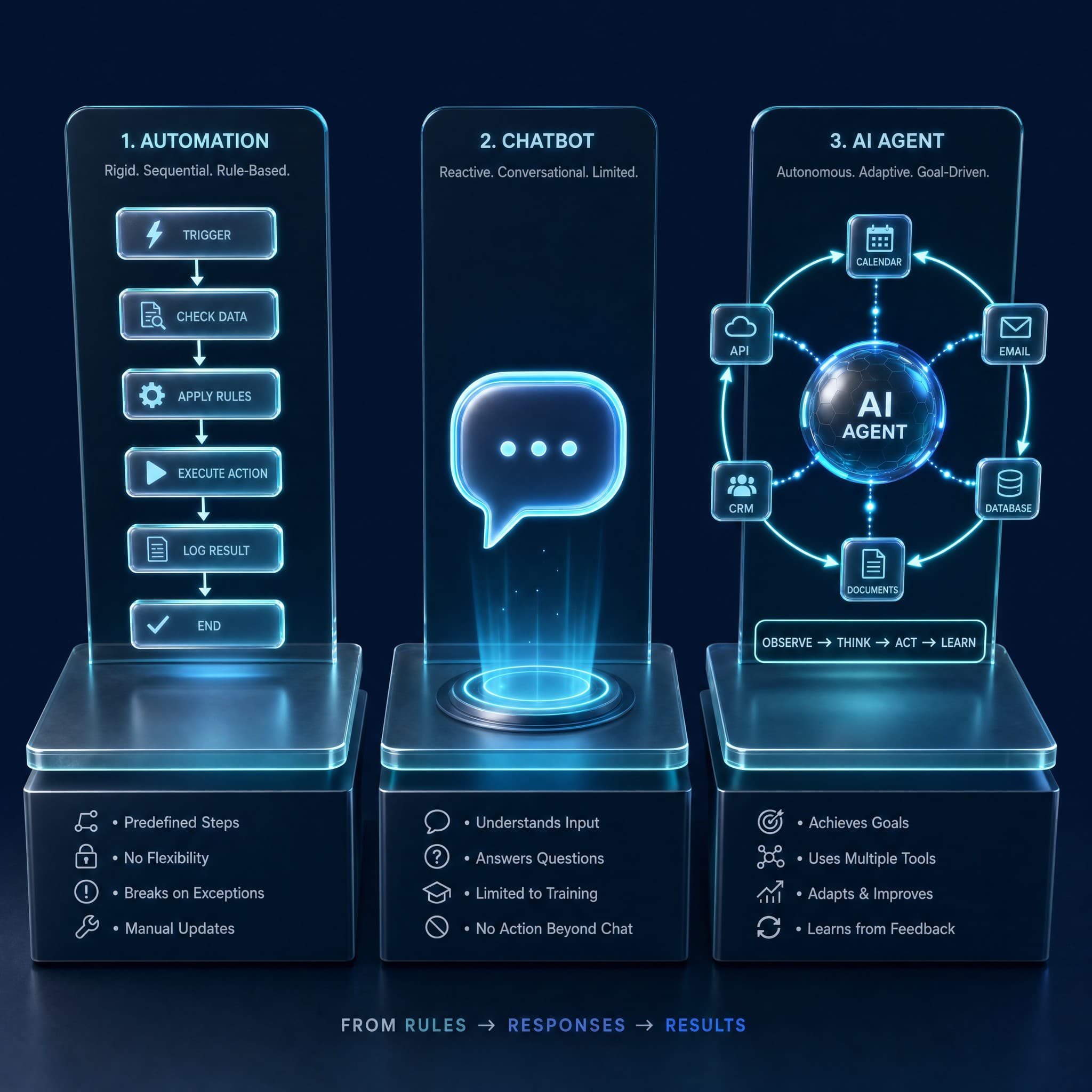
These three concepts are often conflated in software sales pitches. It is essential to distinguish them before investing resources:
Static Automation follows a rigid deterministic logic rule: if trigger X occurs, execute action Y. For example, a new website form lead is appended to Google Sheets and sends an alert email. Tools like Make and Zapier execute these flawlessly, but they lack contextual understanding. Any edge case outside predefined paths results in execution failure. Learn more in our guide to marketing automations.
A Chatbot conducts conversational exchanges. It answers inquiries, gathers contact information, and routes conversations to human reps. Modern LLM-based chatbots generate fluent replies from business documentation, but they remain reactive: responding only when prompted by a human. Read our in-depth analysis of AI chatbots for business.
An AI Agent is assigned an objective rather than an isolated prompt. It evaluates context, formulates multi-step plans, autonomously interfaces with external tools (calendars, CRM databases, websites, email APIs), inspects intermediate results, and self-corrects. Instead of “answer this customer,” an agent receives “qualify this lead and schedule a meeting this week.” Because agents possess autonomous agency, they require scoped permissions and rigorous human governance.
A simple rule of thumb: if a process can be modeled as a closed deterministic flowchart, build an automation. If intermediate steps require contextual reasoning and judgment, deploy an AI agent.
6 Practical AI Agent Use Cases for Israeli SMBs
These examples reflect active operational workflows rather than conceptual theories:
1. WhatsApp Lead Qualification
When an inbound lead messages at 10 PM, the agent conducts a concise conversational intake (assessing scope, location, timeline, and budget), scores the lead against your qualification criteria, and logs the structured profile directly into your CRM. In the morning, you review a prioritized pipeline rather than dozens of unread chats. This operates seamlessly via the official WhatsApp Business Platform rather than personal phone devices.
2. Automated Calendar Scheduling & Confirmations
The agent negotiates available time slots directly with prospects against your real-time calendar, confirms bookings, and sends automated SMS/WhatsApp reminders. If a client requests rescheduling, the agent coordinates alternatives autonomously—saving service clinics, salons, and consultancies hours of administrative overhead weekly.
3. Autonomous SEO Content Publishing
Our proprietary platform, Simpi, demonstrates this end-to-end. Simpi connects to your website, formulates keyword strategies, drafts and publishes complete SEO articles, resolves technical indexing bugs, and tracks SERP movements. Simpi delivers status updates via WhatsApp and requests human approval only for high-impact alterations.
4. Automated Overdue Invoice Follow-Up
The agent monitors accounts receivable, identifies past-due invoices, and drafts courteous, brand-aligned payment reminders. Upon receiving customer replies, it updates accounting statuses and escalates only disputed or non-responsive accounts to human managers.
5. Google Business Review Management
Inbound Google reviews receive immediate draft responses: personalized gratitude for 5-star ratings, and measured, professional resolutions for negative feedback. We recommend keeping response publishing in draft-approval mode during initial deployment months.
6. Automated Executive Performance Briefs
Instead of manually logging into multiple advertising and analytics dashboards, an agent synthesizes data across Google Ads, Meta, and CRM platforms into an executive summary highlighting week-over-week trends, anomalies, and cost-per-lead fluctuations.
Operational Risks to Manage Before Deploying Agents
Because AI agents possess agency, operational safeguards are critical:
- Hallucinations: Language models can invent non-existent pricing, services, or policies. Agents must be strictly grounded in verified Knowledge Bases with explicit instructions to route unknown inquiries to human staff.
- Overly Broad System Permissions: Agents granted unrestricted write access can inadvertently delete records or send unintended messages. Enforce the principle of least privilege and maintain human-in-the-loop approval gates.
- Data Privacy & Regulatory Compliance: Agents processing consumer data operate under data controller laws. Amendment 13 to the Israeli Privacy Protection Law mandates strict visibility over data storage, processing protocols, and vendor AI training terms. Consult official guidance from the Privacy Protection Authority and official Amendment 13 documentation.
- Uncontrolled API Costs: Agents running in recursive execution loops can accumulate excessive token expenses. Configure monthly budget ceilings and execution timeout limits.
Self-Audit Test: In ChatGPT, paste your service page and ask: “How much does [a service not listed on your site] cost?” If the model confidently hallucinates a price rather than stating that information is unavailable, your agent requires stricter knowledge base guardrails.
In a law office these risks weigh more because of the duty of confidentiality. What the Bar Association allows, and where AI really saves time, is covered in AI for lawyers in Israel: what the Bar Association allows, where it saves time and where it is risky.
How to Start Small: A 5-Stage Implementation Plan
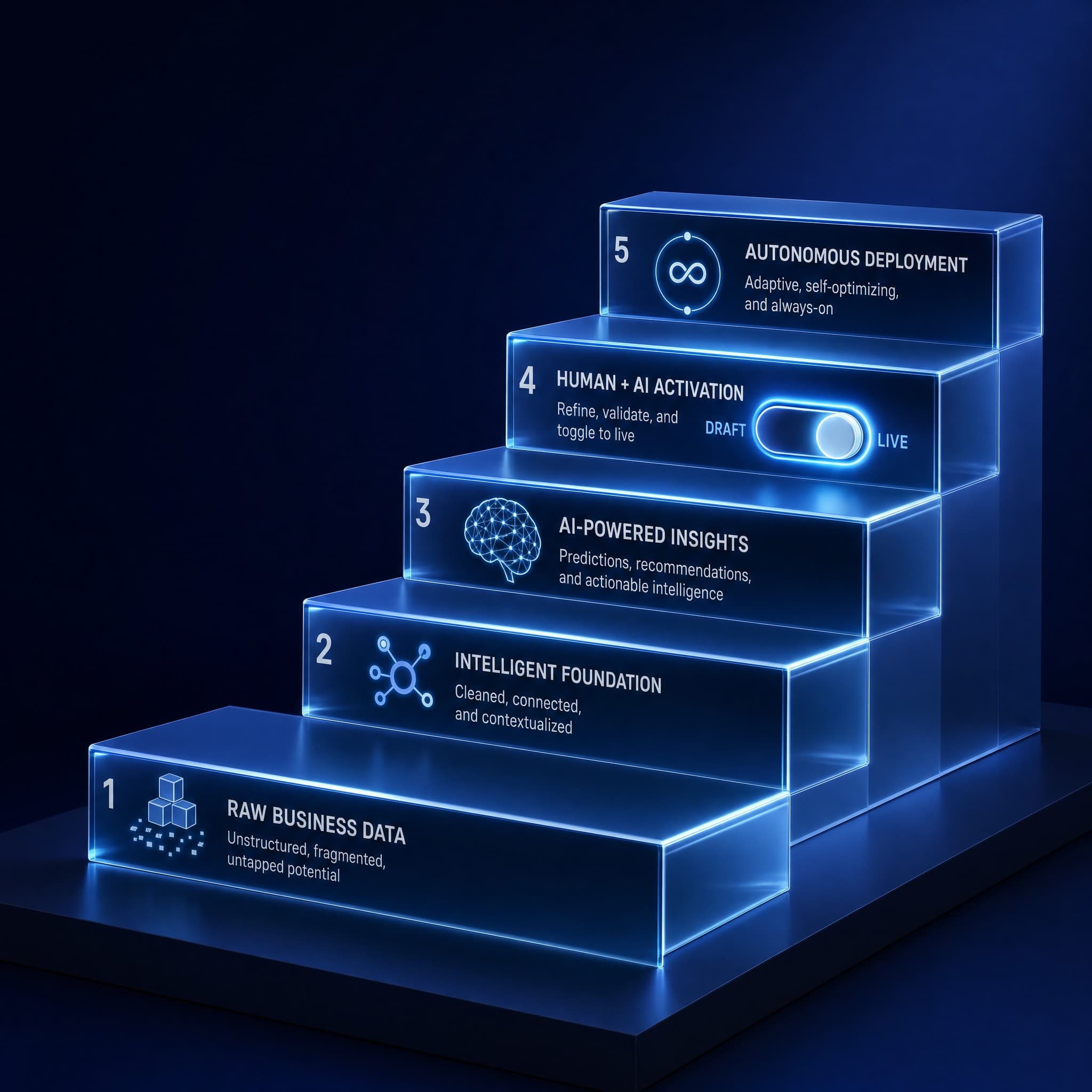
- Select a Single Bottleneck Process: Choose one repetitive, structured administrative task. Inbound WhatsApp lead intake is often the ideal pilot.
- Document Operational Rules Explicitly: If your team cannot explain what constitutes a qualified lead on paper, an AI agent cannot infer it.
- Assemble a Single Source of Truth Knowledge Base: Consolidate pricing models, service descriptions, FAQs, and cancellation policies into a structured master reference.
- Execute in Draft Mode for 2–3 Weeks: Allow the agent to formulate suggested actions and replies while requiring human confirmation before execution. Refine system prompts based on observed errors.
- Graduate to Autonomous Execution Incrementally: Measure response times, escalation ratios, and accuracy metrics before extending autonomy to subsequent workflows.
What We Observe in the Field
When engineering conversational agents, our initial requirement is comprehensive operational documentation: services, pricing tiers, FAQs, and edge-case policies. Without authoritative source material, effective agent alignment is impossible. Our deployment methodology follows a strict sequence: knowledge ingestion, dialogue simulation, CRM/calendar API integration, draft-mode evaluation, and controlled production launch. We never grant unmonitored messaging autonomy without a minimum 2-week validation phase.
The 5 Core Architectural Components of an AI Agent
Every commercial AI agent consists of 5 foundational building blocks:
- Foundational LLM Engine: The reasoning layer (ChatGPT, Claude, or Gemini) that parses context and plans subsequent steps.
- Knowledge Base (RAG): Proprietary business documents and guidelines that anchor model outputs to factual data.
- Tool Integrations: API connectors to calendars, CRM software, WhatsApp Business Platform, and accounting systems.
- Permissions & Audit Logs: Access-control boundaries and comprehensive logging of all autonomous actions.
- Governance Interface: The communication channel where business operators review and approve agent actions—often WhatsApp for mobile convenience.
The Simple Web Approach
Simple Web is an AI-driven digital agency based in Bnei Brak, certified Meta Partners, and Google Ads specialists serving 200+ businesses with 28 verified 5★ Google reviews (discover more on our about page). We engineer two categories of business agents: custom AI chatbots for WhatsApp, web, and social channels with full CRM integration delivered in 1–3 weeks, and Simpi—our specialized AI SEO agent offering technical optimization and automated article publishing at ₪750 + VAT/month. Every deployment emphasizes human oversight: AI executes, you maintain strategic control.
Conclusion
AI agents are powerful digital workers that execute real-world workflows when provided with clear objectives, structured knowledge, and governed tool access. For small businesses, their highest leverage lies in eliminating administrative friction across lead intake, scheduling, review management, and reporting. Learn about everyday tools in our guide on ChatGPT for business. Start with a single pilot workflow in draft mode. Contact our team to schedule a discovery consultation and evaluate AI agent integration for your business.
Tags:
Recent posts