
Chatbots for Business: What They Are, How to Build a WhatsApp Bot, and What It Costs
Chatbots for business answer customers 24/7, filter leads and book meetings. Rule-based vs. AI, building a WhatsApp bot, and what really sets the price.
A chatbot is the cheapest way to make sure no customer is left without an answer. An inquiry that comes in on WhatsApp at ten at night gets a reply within seconds, instead of tomorrow morning at your competitor's. Still, most business owners who ask us about a chatbot for business don't know what they actually need: a simple bot that answers frequently asked questions, or an AI bot that holds a conversation, qualifies leads and books meetings. In this article we explain the difference, how to build a bot for WhatsApp, your website and Messenger, what really determines the price, and what the law requires of you.
What is a chatbot, and how is a rule-based bot different from an AI bot
A chatbot is software that holds a conversation with a customer in place of a person. There are two types, and the difference between them determines almost everything.
A rule-based bot follows a script: the customer taps "Opening hours," and the bot replies with the opening hours. It's cheap, predictable, and suited to questions that repeat in exactly the same form. But the moment the customer writes something that isn't in the script, the bot gets stuck.
An AI bot uses a language model (such as ChatGPT, Claude or Gemini) to understand what the customer wants, even when they write in slang, make spelling mistakes, or ask two questions in one sentence. It's trained on your business's information: your services, prices and frequently asked questions. That's why it can hold a real conversation, not just offer a menu.
Our recommendation for most businesses: an AI bot with clear boundaries. It answers what it knows and hands everything it doesn't know over to a person. That way you get the flexibility without the risk of a made-up answer.
What a chatbot for business actually does
A good bot doesn't just "answer." It does five things, in this order:
- Answers questions about your services, prices, location and opening hours, based on the information you've fed it.
- Qualifies leads: asks what the customer needs, when, and on what budget, and tells a relevant inquiry apart from mere curiosity.
- Books meetings in your calendar, or sends a link to book an appointment.
- Saves the details in your CRM, so no inquiry disappears into a WhatsApp chat nobody opened.
- Hands off to a person when the conversation goes beyond its boundaries, with a short summary of what's already been said.
The fifth item is the most important. A bot that can't say "I'm transferring you to a representative" is a bot that loses customers. So before you build, write a list of the questions the bot is allowed to answer, and a list of what always goes to a person.
WhatsApp bot, website bot, Messenger bot: where to start
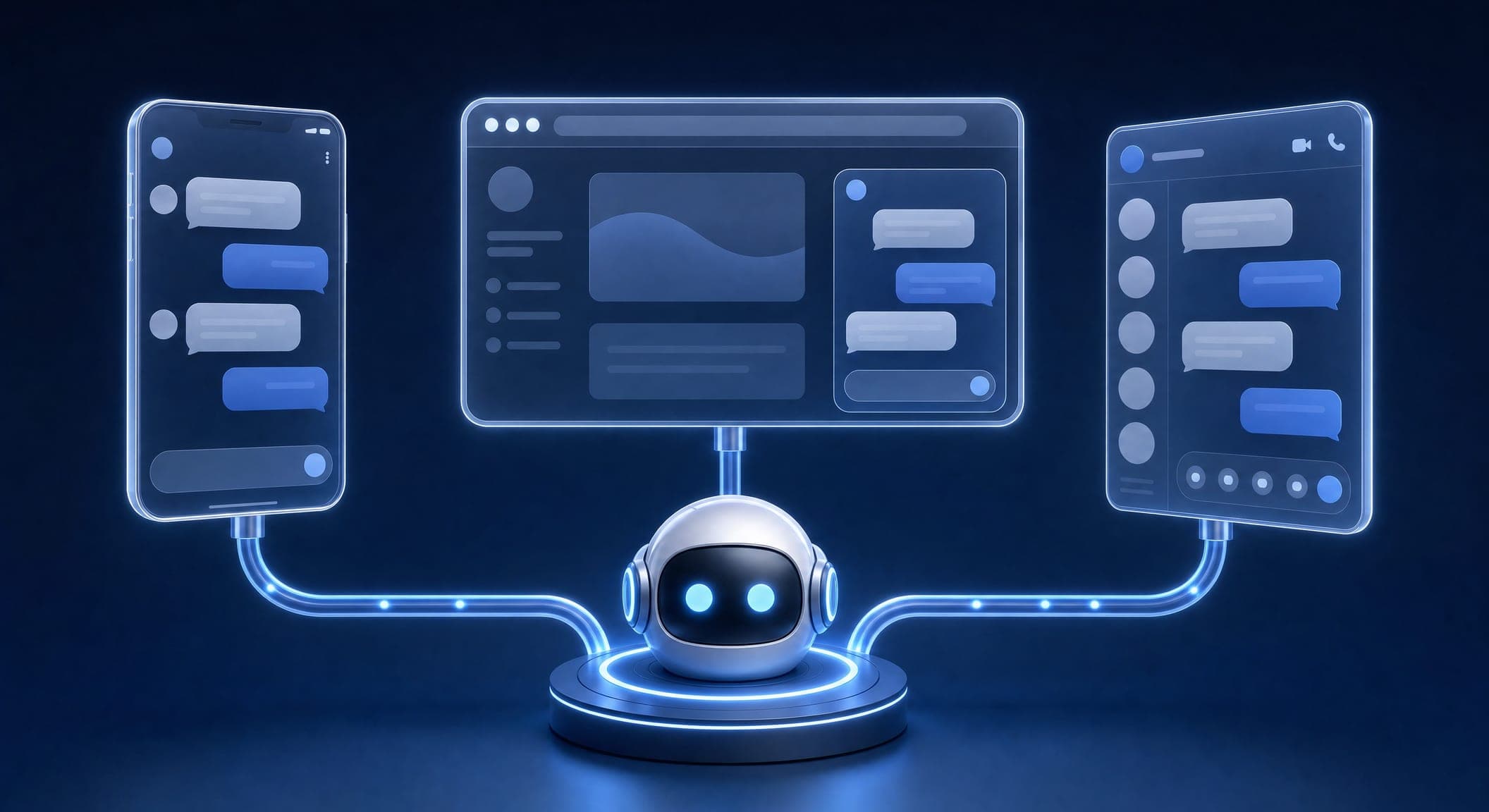
The bot should be where your customers are already writing. In Israel, the answer almost always starts with WhatsApp.
- A WhatsApp bot runs on the WhatsApp Business Platform (Meta's API), not on the regular WhatsApp Business app. That's what lets it answer thousands of conversations automatically at the same time and connect to a CRM. How it works, the difference between the app and the API, and what you're legally allowed to send are covered in our article on WhatsApp marketing for business.
- A website bot sits as a chat bubble in the corner of the screen. It suits sites with traffic, for example from a store or a campaign, because it catches visitors at the moment they're hesitating.
- A Messenger and Instagram bot answers messages that come in from your business page and your ads. If you run campaigns with a "Send message" button, you need one, otherwise the leads sit waiting in the inbox.
The right order: start with the channel where most inquiries arrive, then expand. One bot can serve all three channels and send everything to a single CRM.
Use cases by type of business
The following examples are typical scenarios, to help you understand what you can ask a bot to do:
- A clinic or medical practice: the bot asks which treatment the customer is interested in, offers available slots, sends a reminder the day before, and lets them cancel or reschedule an appointment.
- An online store: answering shipping and returns questions, checking order status, and recommending a product based on what the customer is looking for.
- A law firm or consultancy: collecting initial details about the type of case and how urgent it is, and routing it to the right lawyer. General questions get an immediate answer.
- A service business (renovation, plumbing, cleaning): collecting the address, a description of the job and photos, and scheduling a visit. The bot saves you the round of "what exactly do you need" phone calls.
- Real estate: filtering by area, budget and property type, and sending matching properties.
In each of these cases, the real gain isn't "saving on an employee." It's the inquiries that would have disappeared because no one answered in time.
How much a chatbot costs

There's no single price for a chatbot, because the word covers both a five-question menu and a system connected to your calendar, your CRM and three channels. At Simple Web, the price is set in a quote based on scope, after a free discovery call. What determines the scope:
- Number of channels: WhatsApp only, or your website and Messenger as well.
- Rules or AI: an AI bot requires training on your content and testing, and therefore more work.
- Integrations: connecting to your calendar, CRM, booking system or payment processing. Each connection is a separate piece of work.
- Scope of training: how many services, how many frequently asked questions, how many edge cases need to be covered.
- Ongoing third-party costs: Meta charges for messages on the WhatsApp Business Platform by message type (in 2025 the model moved from per-conversation to per-message billing), and AI models have usage costs. These are the providers' costs, not ours, and they change; check Meta's current pricing before you commit to a budget.
A rule of thumb: if the bot saves you one "what are your opening hours" phone call a day, it has already paid for itself. If it catches one inquiry a week that would have gone to a competitor, it's profitable.
How long it takes, and what the process looks like
With us, a basic bot is ready in about a week. A custom bot, with full training on your services and prices and a CRM connection, takes 2–3 weeks. The process:
- Specification: what the bot answers, what it doesn't, and where a conversation it doesn't understand gets routed.
- Content: you send over your services, prices and frequently asked questions. This is the part that's usually delayed, so start on it even before you've chosen a provider.
- Build and integrations: the channels, the calendar, the CRM.
- Testing: we and the client try to break the bot with real questions.
- Launch and monitoring: in the first few weeks we read the conversations and fix whatever the bot didn't understand.
If you want the bot to also take actions on its own, such as opening a ticket in a system or updating inventory, that's already an AI agent, not just a chatbot. The difference matters for pricing and for risk.
Privacy and Amendment 13: what a bot is allowed to store
A chatbot collects personal information: name, phone number, sometimes medical or financial details. Amendment 13 to the Privacy Protection Law, which took effect in August 2025, requires you to know what information is collected, where it's stored and who it's passed on to. A few rules we stick to:
- The bot says at the start of the conversation that it's a bot, and points to the privacy policy.
- It collects only what's needed for the purpose of the conversation. A hair salon's bot doesn't need an ID number.
- The information is stored in your CRM, not in the language model provider's chat.
- Marketing on WhatsApp requires explicit consent; replying to a customer's own inquiry doesn't.
Exactly what the law requires of business owners, including registering a database and appointing a privacy officer, is covered in our guide to Amendment 13.
What Simple Web does about it
We build AI-powered chatbots for WhatsApp, websites and Messenger. The bot is trained on the business's services, prices and frequently asked questions; it answers, qualifies, books meetings, saves leads in the CRM and hands off to a person when needed. A basic bot is ready in about a week, a custom bot with full training in 2–3 weeks, and the price is set in a quote based on scope after a free discovery call. The bot is usually the first piece of business automation, because it's what brings the leads into the system. Details on the service are on our AI chatbots and automation page. Simple Web is an AI-first marketing agency from Bnei Brak, certified Meta partners and Google advertising experts, with 200+ clients and 28 five-star Google reviews.
A good chatbot is one that also knows what it doesn't know: it answers repetitive questions fast, filters inquiries, and passes on to you whatever needs a human. Start with the channel where customers already write to you, set clear boundaries, and review the conversations in the first few weeks. Want to find out which bot fits your business? Talk to us.
Sources
- WhatsApp Business Platform — what the API enables and how the billing model works
- Meta Business Help Center — automatic reply settings in Messenger and Instagram
- Israel Privacy Protection Authority — obligations for collecting and storing personal information under Amendment 13