
Websites
Website Building for Small Businesses: What You Need, What to Skip & Pricing (2026)
Which pages does a small business really need on a website, what can you skip in year one, when to build it yourself, and realistic pricing in Israel.
Simple Web TeamSeptember 13, 20269 min read
Website building for small businesses is an area where it is surprisingly easy to overpay for features you don't need, while skipping legal and operational essentials. A small business does not require a 30-page corporate portal, but it absolutely needs an inquiry form that reaches your phone in under a minute. In this guide, we break down what a small business site genuinely requires and what is redundant during year one. We review the legal requirements you cannot afford to ignore, when DIY builders make practical sense, and realistic pricing across the Israeli market. No empty lead promises — just proven frameworks from working with over 200 businesses.
What a Small Business Truly Needs on Its Website
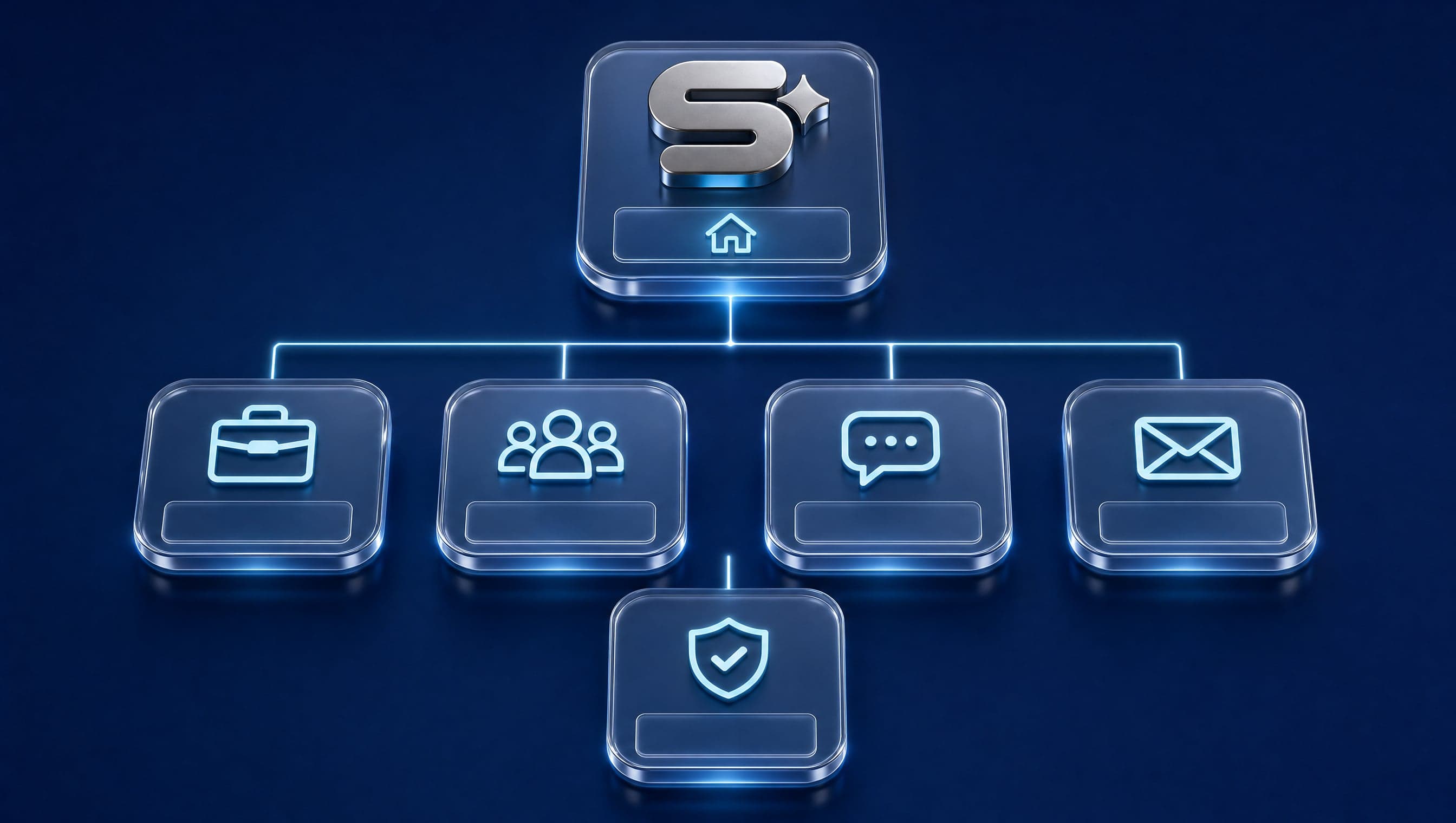
Most small businesses need a compact brand website of 5 to 8 pages – nothing more. Here is the architecture we begin with across virtually every small business engagement:
- Homepage: Explaining in 3 seconds what you do, who you serve, and your geographic area, anchored by a prominent call-to-action button.
- Dedicated service pages: Not a single crowded “Services” list, but an individual page for every core service you want to rank for on Google.
- About page: Showcasing real faces, names, and credentials. In a small business, you are the brand.
- Contact page: Featuring a concise form, WhatsApp click-to-chat, tap-to-call phone links, and Waze navigation buttons.
- Authentic customer testimonials: With real names and photos, rather than generic unverified quotes.
- Legal compliance pages: Accessibility statement, privacy policy, and terms of service.
Beyond page count, four foundational pillars determine whether your site will succeed. First, load speed: a site that loads slowly on mobile loses visitors before they read a single word. Test your speed for free on PageSpeed Insights. Second, responsive mobile design, because in our experience the vast majority of your traffic will arrive via smartphone. Third, synchronization with your Google Business Profile so that local maps and organic search mutually reinforce each other. Fourth, measurement: Google Analytics 4 and Meta Pixel tracking, even if you are not yet running paid campaigns. Without measurement, you cannot know what is generating revenue.
How to test yourself: Open PageSpeed Insights, submit your URL, and check the Mobile tab. A healthy score shows all three Core Web Vitals in green and a performance score above 90. Simultaneously, submit a test form from your phone and verify where and how fast the notification arrives. If the answer is “I don't know,” that is the first problem to solve.
One more detail often omitted from agency quotes: copywriting. Who is writing the text for your service pages? If the answer is “you,” your launch will inevitably stall. Clarify upfront whether copywriting is included, and if not, what it costs. In small business web design, content provision is the single largest gap between proposals that look similar on the surface.
What We See in the Field
During discovery sessions, we never begin with aesthetics. We begin with one question: what must the site achieve over the next six months? From there, our sequence is fixed: objective, page architecture, content authorship for each page, and mandatory integrations (forms, WhatsApp, CRM). In our experience, the most frequent pitfall for small businesses is not building too small, but commissioning too large: ordering 15 pages where content for half of them is never produced. That is why we refuse to start visual design until we establish who writes the copy and by what deadline. Once locked, our strategy document arrives within 3–5 business days, and the site launches within 14 business days. When a single landing page suffices, we state that transparently on the initial call.
What You Do Not Need (At Least in Year One)
This is where the majority of your budget is saved. Based on our client work, these are the costly additions small businesses pay for but rarely utilize:
- A blog with 50 articles on day one: A blog is a fantastic SEO engine, but it succeeds when publishing consistently over time, not by dumping dozens of posts simultaneously. Begin with 3 to 4 strong pillar guides.
- Heavy background animations and video loops: Impressive in desktop demos, but they drastically slow down mobile load times.
- A custom client portal: Unless you manage hundreds of recurring client accounts, custom portal development is an expensive feature for minimal usage.
- A tri-lingual website: Only translate into languages where you have genuine paying customers today.
- A staffed live chat widget: A direct WhatsApp button accomplishes the same result for free, and an automated bot can handle inquiries when you are unavailable.
Rule of thumb: any feature that cannot be directly linked to your core business goal (inquiries, consultations, bookings) should be deferred to version two. If you want to structure this in advance, a concise website specification document accomplishes exactly that.
Legal Obligations You Cannot Afford to Skip
Two statutory requirements apply to every small business website in Israel, and cheap DIY templates almost always ignore them.
Accessibility: Any business offering services to the public must comply with Israeli Web Accessibility Standard IS 5568. Accessibility lawsuits are a very real legal risk. Scope depends on business revenue and service type, so verifying your exact obligations is essential. In practice, this requires color contrast compliance, keyboard navigation, descriptive image alt text, and a compliant accessibility declaration. Read our in-depth website accessibility guide, with official directives published by the Commission for Equal Rights of Persons with Disabilities.
Privacy Compliance: Amendment 13 to the Israeli Privacy Protection Law directly impacts small businesses collecting personal details via web forms. The fundamental principles: disclose what you collect and why, secure stored data, and obtain explicit consent for marketing cookies. We covered the specifics in our Amendment 13 business guide, based on guidance from the Privacy Protection Authority.
Both requirements are inexpensive to build in from day one, but costly to retrofit after a legal notice. They should appear explicitly in your proposal, not as billable surprises. We are not lawyers; reviewing current statutory language or consulting legal counsel is recommended.
DIY vs. Agency: When Building It Yourself Makes Sense
Let's be candid: not every small business needs an agency. DIY platforms like Wix are suitable when three criteria are met: you lack the budget for professional development; the site is primarily for basic legitimacy (“something to show” when people search your name); and you have no immediate plans to invest in competitive Google SEO. In that scenario, a clean single-page site with contact details and WhatsApp is far better than an expensive agency site you cannot afford. Even then, draft a clear objective and page list before opening a template.
Conversely, building with an agency pays off when the website is expected to generate client inquiries. For example: when running paid ad campaigns or SEO, when requiring CRM and calendar sync, or when brand authority is vital to your profession (lawyers, medical clinics, real estate). And simply when your time is scarce: DIY building realistically absorbs dozens of hours that are better spent serving paying clients.
There is also a middle ground: a high-converting single landing page (delivered in 5–7 business days) or a digital business card. For single-service businesses, that is often ideal initially. A technical breakdown of Wix, WordPress, Webflow, and Next.js is available in our website platform selection guide.
How Much Does Small Business Web Design Cost in Israel?

Market rates across Israel vary widely, so we present these as realistic industry benchmarks based on our experience, not fixed Simple Web tariffs:
- DIY Builders (Wix, Site123, etc.): Monthly subscription of several dozen shekels up to ~₪150/month, plus your personal hours. Low cash outlay, but the end result depends entirely on your design and technical skills.
- Freelancer: Typically ₪2,500–7,000 for a basic brochure site. Quality varies significantly, and accessibility, technical SEO, and long-term support are frequently omitted.
- Agency: Typically ₪5,000–15,000+ for a custom brand website, depending on page volume, copywriting, custom UI, and system integrations. E-commerce stores start higher.
What drives the final price? Primarily page count, whether professional copywriting is included, bespoke design versus premade templates, and third-party integrations (CRM, payment processors, scheduling). Always clarify what is covered post-launch: hosting, backups, security patching, and minor content adjustments. See our full breakdown in our website types and costs comparison.
What Simple Web Does
Simple Web is an AI-driven digital marketing agency in Bnei Brak, certified Meta Business Partners and Google Ads specialists, working with 200+ businesses and holding 28 five-star Google reviews (read more on our About page). A custom brand website with us starts at ₪5,000 (ranging from ₪5,000–15,000+ by scope), completed within approximately 3 weeks (14 business days). It includes modern SEO foundations, CRM webhooks, mobile responsiveness, and an intuitive CMS allowing you to update text and imagery independently. Since 2025, every website we engineer incorporates consent management configured for Amendment 13 compliance. Furthermore, every website project includes 6 months of complimentary SEO content writing (₪4,500 value), ensuring your digital asset starts ranking immediately. Portfolio examples include Handi's Barbershop, Meboo Kitchens, and Avi the Exterminator. The process begins with a free diagnostic consultation where we gladly tell you if a full website is unnecessary and a landing page or digital business card would serve you better.
Summary
Building a website for your small business does not need to drag on for months or cost tens of thousands of shekels. You need 5 to 8 focused pages, a reliable lead form, WhatsApp integration, fast loading speed, accessibility, and privacy compliance – while leaving the rest for phase two. If your goal is commercial lead generation, professional development is a wise investment; if your goal is simple presence, DIY tools can suffice. Want to know what makes the most sense for your business? Book a free diagnostic consultation with us today.
FAQ
In the Israeli market, benchmarks range approximately: DIY builders at several dozen shekels to ~₪150/month; freelancers at ₪2,500–7,000; and full-service digital agencies at ₪5,000–15,000+ depending on scope. At Simple Web, a custom brand website begins at ₪5,000, launches within 3 weeks (14 business days), and includes 6 months of complimentary SEO content (₪4,500 value).
With us, a brand website is delivered within approximately 3 weeks (14 business days), assuming client assets (logo, imagery, feedback) arrive on schedule. A standalone landing page takes 5 to 7 business days. Most project delays in the industry are caused by delayed client materials, not software engineering.
Usually not. Social media profiles do not rank in Google search for local intent queries, you do not own the platform audience, and you cannot direct inquiries straight into an automated CRM. However, social pages serve as excellent complementary channels alongside an owned website.
Not on launch day. A blog drives organic SEO growth only when articles consistently answer real customer search questions over time. Start with 3 to 4 strong cornerstone articles, then publish on a predictable cadence. That is why we bundle 6 months of ongoing content with every site.
A brand website presents your entire company: services, about, client testimonials, contact options, and long-term SEO structure. A landing page is a single focused page with one specific offer and a single call-to-action, engineered primarily for paid ad campaigns. For single-service businesses, a landing page can be sufficient initially.
Annual domain registration and web hosting (typically several hundred shekels per year), software security updates and automated backups, and fresh content if you aim to expand organic search traffic. Always confirm upfront what is bundled in your agency agreement versus billable maintenance.
Tags:
Recent posts

AI Website Building: What AI Does and What Still Requires Humans (2026)
September 13, 2026


Why Every Business Needs a Website in 2025
January 15, 2025