AI Website Building: What AI Does and What Still Requires Humans (2026)
AI website builders promise a live site in minutes. What actually comes out, what AI does in an agency build, and what still demands human expertise.

Over the past year, AI website building shifted from an abstract promise into a tool anyone can try for free in minutes. You enter a business description, and an automated AI website generator spits out a full site: layout, copy, stock visuals. The real question is not whether it generates something, but what that output actually achieves and who it is suited for. In this article, we break down what automated AI builders genuinely deliver, what AI does in professional agency development, and what still requires a human: strategy, brand voice, conversion mechanics, proper Hebrew/RTL localization, and legal compliance. No hype — just daily practice from our agency workflow.
What AI Website Builders Actually Do
Building a site with AI on Wix, Gamma, or similar builders almost always follows an identical path. You answer a few onboarding questions: industry, business name, aesthetic preference. The AI picks a template, generates placeholder paragraphs for each block, places stock imagery, and stitches together a 3-to-5 page site. Within minutes, you have a live URL. It is undeniably impressive, and in specific scenarios, that is all you need.
When it is sufficient: Personal landing pages, event announcements, hobby projects, or newly launched businesses that simply need “something to show” on Google while operating without an initial budget. A fast AI builder is also helpful for testing a proof-of-concept before committing capital.
When it falls short: Whenever the website is expected to generate qualified leads and commercial sales. Automated builders generate generic text suited to any competitor in your niche, convincing almost no one. Furthermore, Hebrew copy is often awkwardly translated, architecture lacks SEO hierarchy, CRM webhooks are missing, and mandatory accessibility or privacy pages are absent. You end up with an AI website that looks passable on the surface, but fails at the primary purpose for which it was created.
AI Website Building in a Real Agency: What AI Does in Practice

At an agency working methodically, an AI-built site does not mean “clicking a magic button.” AI integrates into specific stages of our pipeline, compressing tasks that previously consumed days into focused hours:
- Research: Competitor analysis, keyword clustering into page silos, mapping common customer pain points. What once took an entire workday is now drafted in under an hour, yielding a structured initial specification.
- Content Drafting: ChatGPT, Claude, and Gemini draft initial copy for every page based on the spec and brand voice guidelines. Crucially: an initial draft, never the final copy.
- UI/UX Design & Imagery: Section variations in Figma, tailored brand visuals rather than stock cliches, cleanup and compositing in Photoshop.
- Code & Integrations: Scaffolding reusable components, dynamic forms, and webhook integrations, accompanied by rigorous human code review for every line touching user experience.
- Quality Assurance (QA): Scanning for broken links, baseline accessibility compliance, mobile speed auditing against Core Web Vitals, and descriptive image alt tags.
- Post-Launch Growth: Drafting topical authority articles, resolving technical SEO crawl issues, and tracking rank shifts. That is precisely what Simpi, our AI agent, handles directly inside WhatsApp.
The practical outcome: substantially shorter build cycles without sacrificing custom engineering. This allows us to deliver a complete brand website within 3 to 5 weeks (depending on the size of the project). Notice what is missing from that list: not a single phase where AI independently decides what the site must achieve. That responsibility remains squarely with experienced humans.
What Still Requires Humans
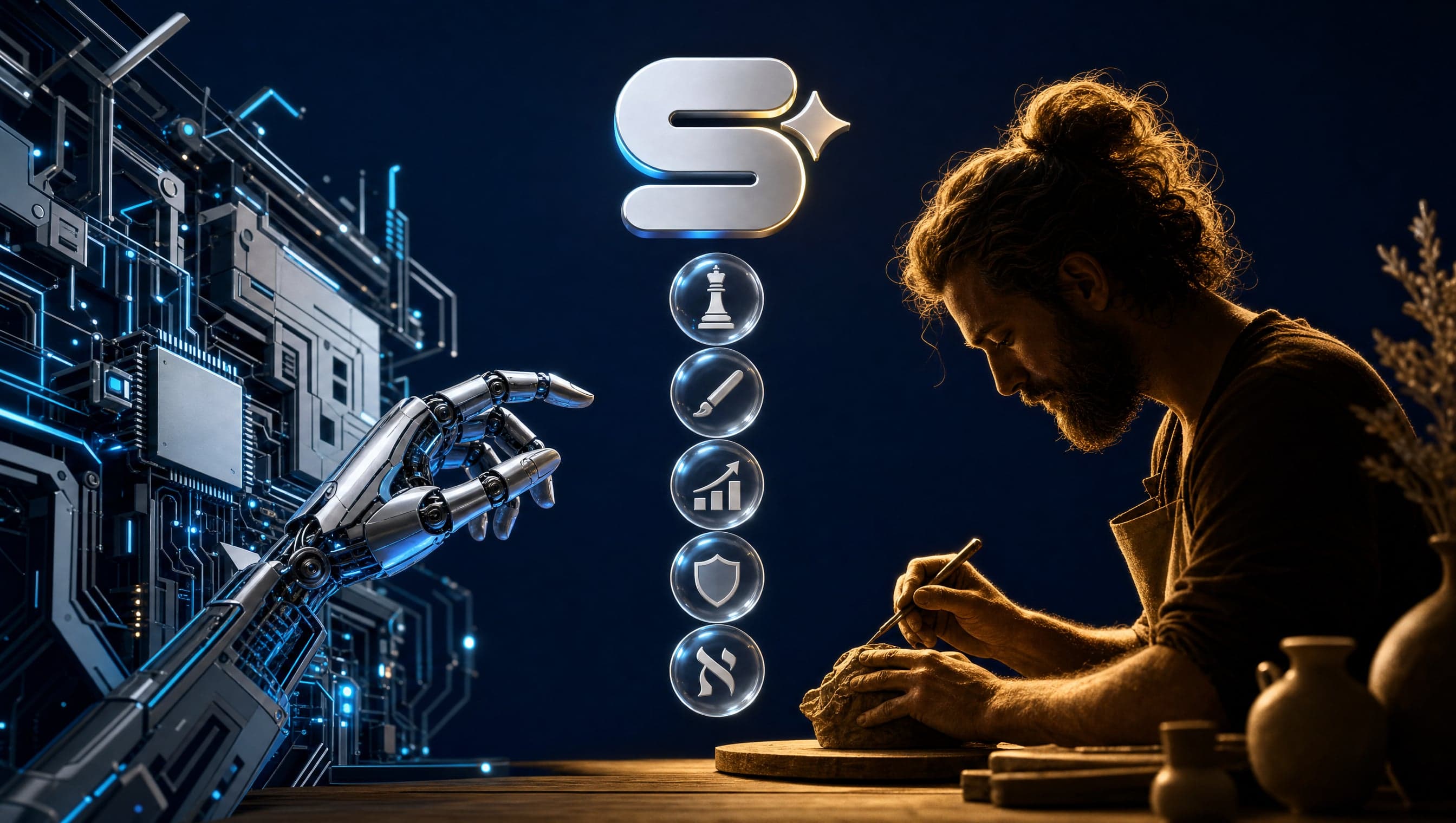
Here lies the distinction between an AI build that produces an attractive shell and a website that drives commercial growth. Five core elements that AI cannot resolve alone, and won't in the foreseeable future:
- Strategy: Defining the business objective, profiling the target audience, and engineering the conversion funnels. AI can suggest ideas, but decisions require intimate familiarity with the business. That is why every project at Simple Web begins with a website specification, never with an ad-hoc prompt.
- Brand & Voice: AI drafts sound like every competitor in the category. A human must infuse your authentic story, distinct tone, and unique value proposition.
- Conversion Optimization (CRO): Button placement, CTA microcopy, field counts on lead forms, post-submission routing. These decisions stem from behavioral data and real customer psychology, forming the gap between aesthetic decor and a lead-generation asset.
- Compliance & Local Regulations: Amendment 13 to the Israeli Privacy Protection Law, Israeli Web Accessibility Standard (IS 5568), and local payment gateways like Bit. Global tools are completely blind to these. We are not lawyers; reviewing current statutory language or consulting counsel is always recommended.
- Hebrew & RTL Nuances: Natural phrasing rather than translated syntax, flawless Right-to-Left alignment across UI components, and mobile Hebrew typography. This demands an experienced human eye reading native Hebrew.
This embodies our core philosophy: “AI works. You decide.” AI generates; humans discern.
Common Pitfalls in 100% AI-Generated Websites
We encounter purely AI-built sites almost weekly during discovery audits. The same mistakes repeat predictably:
- Generic Copy: “We provide professional and high-quality services to our valued clients” – an empty sentence repeated across every page.
- No Path to Conversion: The site looks sleek, but the contact form sends emails to an unmonitored inbox, and there is no direct WhatsApp CTA.
- Duplicate Architecture: Three separate pages conveying the same generic message, with zero dedicated pages targeting specific commercial keywords.
- Zero Analytics: No Google Analytics 4, no Meta Pixel – rendering marketing ROI completely unmeasurable.
- Missing Legal Pages: Lacking an accessibility statement and privacy policy exposes the business owner, not the software tool.
- Sluggish Performance: Heavy template bloat with unnecessary scripts. Check web.dev to see what Google benchmarks in Core Web Vitals.
Many of these flaws plague amateur hand-coded sites as well, as detailed in our guide on the 5 common website mistakes. AI website builders simply produce them at greater speed.
How to test yourself: Open PageSpeed Insights, submit your URL, and inspect the Mobile tab. A healthy score shows green Core Web Vitals and performance exceeding 90. If LCP exceeds 2.5 seconds, heavy template scripts and unoptimized media are the primary culprits.
What We See in the Field
When a prospect brings us an AI-generated site, our audit sequence is consistent. First, measurement: is GA4 active? Is the Meta Pixel installed? Second, the conversion funnel: we submit a test form to see where data routes. Third, legal compliance and mobile load speed. Only then do we review copywriting. In our experience, the most widespread failure is not ugly design, but a lead form submitting to an email address nobody ever checks. What did we stop doing? Using AI drafts as final copy. Every single piece of text now undergoes a native Hebrew editor before publishing. We summarize findings in a comprehensive strategy roadmap within 3–5 business days following the initial consultation.
How to Choose: AI Builder, Freelancer, or AI-Driven Agency
Your choice hinges on three questions: what is the goal, what is the budget, and who maintains the site after launch. AI touches all three avenues today; the difference lies in human accountability and support when issues arise.
- AI Website Builder: Best when budget is near zero, conversion goals are nonexistent, and you are willing to edit content yourself. Estimated cost: tens of shekels up to ~₪150/month.
- Freelancer: Suitable for small brochure sites with limited budgets, provided they understand SEO, accessibility, and RTL mechanics. Inquire who handles ongoing maintenance after deployment.
- AI-Driven Agency: Essential when the website must perform: qualified leads, ad campaigns, CRM routing, and continuous content growth. The advantage is pairing AI speed with human accountability for business outcomes. We explored this in our comparison of AI agencies vs. traditional agencies.
A valuable question to ask any provider: “What exactly does AI handle in your workflow, and who verifies its output?” Vague answers reveal a lot.
What Simple Web Does
Simple Web is an AI-driven digital marketing agency based in Bnei Brak, certified Meta Business Partners and Google Ads specialists, collaborating with 200+ businesses and holding 35 five-star Google reviews (learn more on our About page). AI website building is where this advantage shines most. We leverage ChatGPT, Claude, and Gemini for research and drafting, Figma and Photoshop for design, Supabase and Cloudflare for infrastructure, and Make and Zapier for automations. At every juncture, an agency professional makes the final call. A custom brand website starts at ₪5,000 (ranging from ₪5,000–15,000+ depending on scope), delivered in 3 to 5 weeks (depending on the size of the project). It includes out-of-the-box SEO and AI Search architecture, CRM integration, and a self-service CMS. Every website project includes 6 months of complimentary SEO content articles (₪4,500 value). Post-launch, Simpi continues driving organic rankings via WhatsApp at ₪750 + VAT monthly (launch pricing, 3-month commitment). Read more about our philosophy on our AI-driven marketing services page.
Summary
Building a website with AI is not an all-or-nothing question. It is about what AI executes and who makes the final decisions. Automated builders yield a generic page in minutes for basic presence. Inside an agency, AI accelerates research, drafting, UI design, code, and testing, while human experts safeguard strategy, branding, conversions, Hebrew nuance, and legal requirements. That synergy transforms a decorative website into a revenue-generating asset. Want to see how this applies to your brand? Schedule a free diagnostic consultation with our team.