
Brand Website vs Sales Website: The Difference and What Fits Your Business
A brand website and a sales website serve different goals. 7 practical differences, a quick self-check, what each costs, and why most businesses need both.
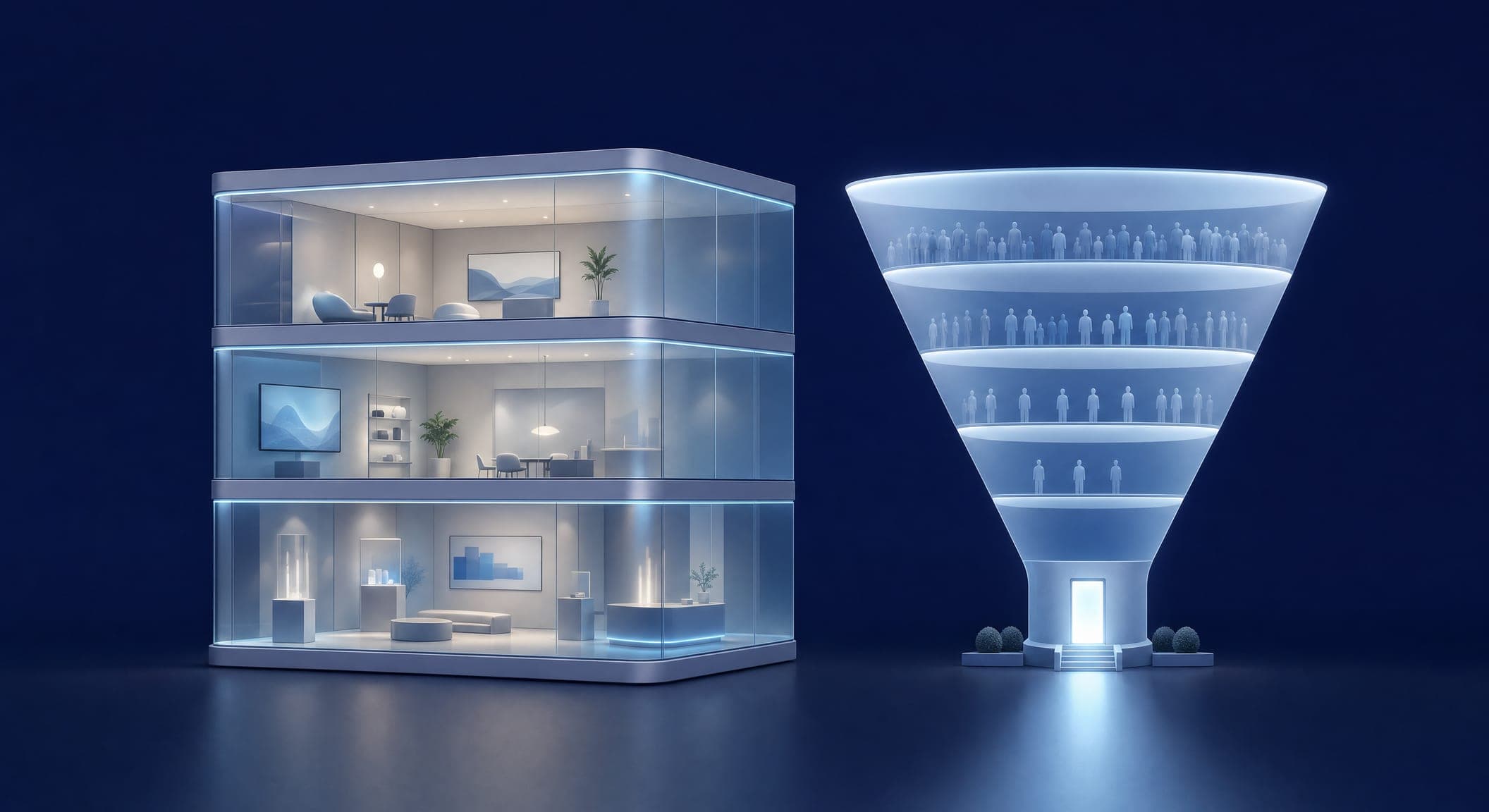
"I need a website" is the most common opening line in our conversations, and what follows is always the same question: which kind? A brand website and a sales website (also called a sales-driven website) are two very different types of sites, in design, in content and in business purpose. A business that builds a brand website when it needs a sales website loses leads and sales. A business that builds a sales website when it needs a brand website looks cheap and unprofessional. In this article we explain the difference, give you a short self-check, talk about pricing, and explain why most businesses actually need a combination of the two.
Brand website: what it is and why it exists
A brand website is your business's digital calling card. Its goal: to establish trust, show professionalism, and give potential customers all the information that will lead them to decide you're the right provider. It isn't built to "sell now." Its job is to build trust over time.
The classic structure: a homepage, a detailed About page, a page for each service, a portfolio, testimonials, a blog and a contact page. The design is usually clean and understated, and the call to action is soft, along the lines of "Want to talk?" rather than "Buy now." Who needs a brand website? Lawyers, accountants, architects, consultants, B2B companies, boutique brands. The principle is simple: anyone whose deal requires a high level of trust rather than a spontaneous purchase. We detailed what it must include in our complete guide to building a brand website.
Sales website: what it is and why it exists
A sales website is built to do one thing: convert. The visitor goes through a planned journey: a headline that grabs them, a value proposition, social proof, objection handling, a call to action. Every pixel on the page serves that goal.
It comes in three common forms:
- Landing page. One page, one message, one action. Suited to a paid campaign or a defined offer. See 10 landing page examples by industry.
- Online store. A catalog, a cart, payment processing and shipping. That's already a system, not a page, and it has its own separate guide.
- Sales funnel. A series of pages that lead from one to the next, usually built around a course, a digital product or a fixed-price service.
The design of a sales website is bold and directive, sometimes with urgency: a countdown timer, "only 3 left in stock," "sale ends tomorrow." Who needs a sales website? Anyone selling a product or service with a quick purchase decision: cosmetics, fashion, online courses, fixed-price B2C services, and any business running paid campaigns.
7 practical differences worth knowing

- Goal. Brand = long-term trust. Sales = immediate conversion.
- Structure. Brand = several linked pages. Sales = one page or a focused funnel.
- Content. Brand = broad, in-depth, educational. Sales = focused, specific, driving action.
- Design. Brand = calm and understated. Sales = bold and directive, sometimes with urgency.
- Call to action. Brand = "Want to know more?" Sales = "Buy now" or "Leave your details."
- Traffic source. Brand = organic search, referrals. Sales = paid campaigns, social media.
- Measurement. Brand = time on page, inquiries, return visits. Sales = conversion rate and cost per lead.
The last difference is the most important in practice. If you don't know how you'll measure success, you haven't yet decided which website you're building.
How to decide what fits your business

The key question: how long does it take your customer to decide? If the journey is long (they research, compare, ask for advice, and decide after days or weeks), you need a brand website. If it's short (they see, decide and buy within minutes or hours), you need a sales website.
A quick self-check, three questions:
- Does the customer pay a significant amount in the first transaction?
- Are several people involved in the decision?
- Does the customer need to trust you before they buy?
"Yes" to at least one of them: start with a brand website. "No" to all three: start with a sales website. And if you answered "yes" and you also run campaigns, read on to the next section.
Three examples: what the decision looks like in practice
To illustrate, here are three hypothetical businesses and what each of them needs:
- An accounting firm. The client checks, compares, asks a friend for advice, and only then calls. The engagement is large and ongoing. A brand website with a page for each service, the team and articles. A landing page gets added only if a campaign runs for a single service, such as tax refunds.
- An online jewelry store. The customer sees an item on Instagram, taps it, and buys or doesn't buy within minutes. An online store with strong product pages and a short checkout. There is an "About" page, but it isn't the core.
- An independent fitness coach. A combination: a campaign for an 8-week program leads to a landing page with a form, and a small brand website behind it presents the approach, the prices and the schedule. The client lands on the page, checks out the website, and comes back to leave their details.
In all three cases the decision follows from the customer journey, not from personal taste and not from what competitors have.
The combination: what most businesses really need
In practice, most businesses need both models together: a full brand website and dedicated landing pages for campaigns. The reason is that the customer journey is hybrid. They click an ad, land on a landing page, want to check that you're serious, click "About," and end up on the brand website. Without a website behind the landing page, some customers simply don't leave their details.
The combination gives you the best of both worlds: landing pages that capture leads from campaigns, and a brand website that establishes that you're professionals. Both share the same brand, the same colors and the same tone, each with its own role.
How much each type costs
- Brand website. With us it starts from ₪5,000, within a typical range of ₪5,000–15,000+ depending on the number of pages, the design and the content. Every website order includes 6 months of free SEO articles (a ₪4,500 value).
- Landing page. Quoted by scope: one message, a short form, connected pixels, ready in 5–7 business days. What drives the price in the market and what's included at each level is explained in our article on landing page cost in 2026.
- Online store. ₪8,000–30,000 depending on the size of the catalog and the integrations.
A brand website combined with a first landing page is priced together, and it usually comes out cheaper than two separate projects, because the specification and the design are shared.
What Simple Web does about it
We're an AI-first marketing agency from Bnei Brak, certified Meta partners and Google advertising experts, with 200+ clients and 28 five-star Google reviews. In the free discovery call, we first understand your customer journey, and only then recommend: a brand website, a landing page, a store, or a combination. We build all of them with the help of AI, with an SEO foundation, a CRM connection and conversion tracking from day one.
In summary: a brand website and a sales website are different tools for different needs. The question isn't "either-or," but where to start. Want to know what fits your business? Tell us what you sell and to whom, and we'll come back to you with a recommendation.
Sources
- Google Search Central — SEO Starter Guide — why a multi-page structure with dedicated content ranks better in search